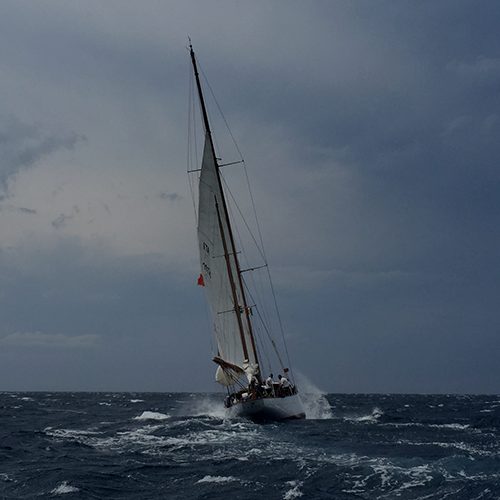
When we bought our yacht we had grand designs of circumnavigation and adventure. White sand beaches, palm trees, coral reefs and tiny remote island hideaways were calling, not to mention the challenge of attempting to get to such exotic destinations by wind power alone.
What we had not planned for was finding out sailing life would suit us so well that we would have children on board and keep on cruising. Not just despite having kids, but largely because of them.
Back in 2010 I had never even set foot on a sailboat. I was working for an architectural practice in London, living with my boyfriend, enjoying the myriad pleasures of a city-paced existence.
Things were good and we were happy, so it is strange to think all it took was a trip down to Cornwall to change our lives forever. Yet it was during a wander along a seaside cliff path that I looked out over the water and murmured it would be such a great idea to buy a boat and go off sailing.
It is funny how quickly a crazy suggestion can become a reality. Because, somehow or other, we did manage to do just that.
We researched and viewed and eventually found exactly the boat we wanted. We also trained and practiced and convinced ourselves that we understood a thing or two about sailing.
In the beginning I knew nothing about life aboard a yacht, let alone how to control and manoeuvre one. But I was enthusiastic about it and eager to bring my knowledge up to match my boyfriend’s, who had sailed a season in the Caribbean, in order to be able to support each other in the boating life.
Then, less than a year after first even toying with the thought of it, we set sail from the UK.
During the first year we learned so much and covered a lot of ground.
We sailed the English Channel and the Bay of Biscay; hopped down along the coast of western Europe to Morocco and the Canary Islands; crossed the Atlantic Ocean and then spent a year circling the Caribbean.
All of it had been organised and dreamed of as part of our preparations to leave England. All of it was timed to be in each place during the prime weather seasons. The result being, every aspect of our new lives was spent in blissful, tropical sailing freedom full of delights, which we relished and basked in.
And then we decided to change the plan entirely.
One down
We had never said it categorically but my partner James and I had intended to live and cruise on our boat and sail around the world for “a couple of years”. Although never uttered aloud, we admitted retrospectively that we had both assumed upon our return from our boating adventures we would do all the normal things like go back to work, get married and start a family.
But another notion had been seeded in us that first year at sea and, without realising it, had begun germinating at the back of both our brains: “what happens if we don’t stop?”
In the Canary Islands we had been greeted at one marina by a pair of sisters under six who bounced up to us, all smiles and fearless friendliness, proclaiming they lived on a ketch and had been born in Portugal. I distinctly remember how tickled and impressed we were at their forthcoming nature and how much it differed from what we had assumed was the typical shyness of many young kids.
Then, while in Cuba, we struck up a friendship with a South African couple sailing on a catamaran with their three children. These three were fun, intelligent and just a little bit feral. They always skipped about the deck with complete ease; the boat was their home and their movements around it seemed so relaxed.
But it was when we did a quick trip to Costa Rica from Panama in order to renew our visas, we bumped into a pair of Americans who were happily backpacking with their 18 month old daughter and so a mischievous seed suddenly sprouted roots.
The two things were not mutually exclusive: we could still start a family while sailing round the world; so that is exactly what we did.
As always I approached the concept of parenthood with the same planning and research skills that had got the boat trip started in the first place. I reasoned it would be sensible to try to time our having a baby during the height of storm season, in order to co-ordinate the boat downtime with having a newborn.
We decided that if we got pregnant then we would put off the Pacific crossing for another year. By the time we went through the Panama Canal I was already at the end of my first trimester and we agreed that an ocean passage might a bit cavalier, even for us. So, we turned right, explored Pacific central America and fought against wind, current and all sailing common sense in order to reach Mexico.
Although I am sure our family back home were initially surprised, they were fairly encouraging of our decision. I should admit that I was really lucky with my own health throughout.
The old landlubber picture I had formed in my head of what our life would look like as we prepared to have a baby, included me starting maternity leave from a stable job, spending weekends decorating the nursery, buying adorable little onesies and chic maternity clothes from the shops in town while seeing my family doctor for regular check-ups.
The reality was that my pre-baby to-do list included spending three months travelling over two and a half thousand miles from Panama to Banderas Bay, navigating a foreign medical system to find a birth centre in a language we were only just learning; all the while preparing our home for the onset of storms and hurricanes.
Our daughter, Rocket, was born in Mexico in 2013. We had travelled inland from the boat to the birth centre so we spent the first five weeks of her life living in a hostel in Guadalajara.
But strangely we were not alone. The marina that we proudly returned to with our baby girl was a veritable social whirl of birthday parties, poolside barbeques, dock gatherings and pot-lucks all aimed at families on yachts.
The cruising community there threw us a baby shower, the marina manager became a doting extra auntie and we soon learned about several other families on yachts who had just had or were expecting babies in the same year.
It turns out that we were not as unusual as we thought; or at least that we had found a whole bunch of equally extraordinary sailing families.
Yet there were some ways in which life with an infant on board was like getting onto the boat for the first time all over again because we were always carrying her. Getting used to negotiating your way around a boat while it is moving at anchor or on passage is like learning to dance in time with the rhythm of music. Once you have the hang of it, it is second nature. But that instinctive bob and sway is connected to your own weight and balance, additional pounds of bouncing baby inevitably change your equilibrium and it takes a while to regain your steadiness. For example my expert lasso technique when berthing became tricky when pregnant and downright risky with a baby strapped to me, so we had to find new ways
of adapting our docking.
We were new parents, on the other side of the world from our family and home culture, adjusting to yet another aspect of this new lifestyle for ourselves with complete freedom to do so. There was no baby gear needed for us: no cot, carseat or buggy. Frankly, given the temperatures in the tropics, there were barely any clothes on our little girl most of the time.
There was also no limit to the paternity leave, no packing our little one off to daycare and never a need for a babysitter. What we had almost accidentally stumbled across was a way for us to both be with our baby all of the time, thanks to living on the boat. The yacht was remarkably baby-proof and suddenly had a dual purpose as
it was now equal parts vehicle and family home.
In a world where there is so much talk about how difficult it can be to have children or what hard work it is, in the early days of having a baby we were at the other end of the spectrum: having the time of our lives, finding everything so simple and easy.
A lot of that was largely because there were two of us going through the whole experience together. In the period following Rocket’s birth, she was taken on quite a few adventures: she flew in aeroplanes; she rode on a speedboat,
a houseboat, a pontoon boat and a kayak; she met dolphins and whales but also goats, cats, horses, dogs, geckos, iguanas and deer; we had her splash about in a plunge pool, a swimming pool, a bath, a bucket, a lake in Canada and, of course, the Pacific Ocean.
This was most definitely a life less ordinary for an infant yet none of it was planned to be so. We were not aiming at an entirely impulsive or unstructured existence for our newest crewmember, in fact the contrary was true. She was simply included with whatever we were doing.
We knew starting a family while travelling would mean that we would need a lot of humour and the ability to stay relaxed. It was always bound to look different from staying at home in the UK. There would not always be a changing table available or the perfect tranquil location in which to feed my baby. So, we chose to roll with it.
The result being that her needs were met sooner, even if it meant that she had a nappy change in the middle of the woods when we were hiking or breastfed while we were riding a crammed public bus.
That first year of cruising had made our already strong partnership transform into a solid and supportive team. We relied on each other’s strength and judgement in order to cover all those ocean miles and this new challenge was no different.
The fluid nature of the daily boating rhythms meant that we could take turns with the baby, allowing each other enough time to take naps and breaks and anything else we needed to stay happy and balanced. But the routine of the father going out to work and the mother staying at home with the baby does still apply even in this regime as boats need constant attention, maintenance and responsiveness.
Bringing up baby
It is almost as if we already had a child before the baby, one that is 42 foot long and a lot more troublesome!
Of course, things were not always perfect. Sometimes having a baby feels like damage control. You can easily spend a whole day consoling your howling infant from their latest fall, pre-emptively snatching away all the tempting unsuitable objects that they manage to get their sticky hands on or spending a good hour jiggling, rocking and crooning your little one to sleep only to have them awaken red-faced and tear-stained only moments later.
Sometimes having a boat is the same thing. The urgent jobs that pop up out of nowhere; the repairs that require huge amounts of time, energy, strength or money to fix; lengthy trips to strange towns and unusual out-of-the-way shops, suppliers or machinists to try to find a solution to a tricky boat problem. We were able to tag-team on certain tasks and talk through them enough to share the mental burden of each job.
But, like any family, we still had to make three meals, wash up afterwards and respond to the needs and desires of our little crew. I had to handle my duties in bursts as I might get interrupted to feed our daughter at any point. So things that could be easily stopped were good for me to do: laundry, washing up, researching. Anything involving chemicals suddenly became a bit trickier, although I did still handle the majority of the domestic cleaning.
Boat life involves being more environmentally conscious, aware of what you consume and ensuring there is enough food and fresh water.
I try to keep up with the laundry and make time to hand-wash all the cloth nappies. Generally keeping things shipshape is still of vital importance in order to keep the boat safe and functioning. Most of the time things would work well, although there are always good days and bad days.
Two down
Fortunately, we were finding that we were having a lot of good days. In fact, it all worked so well, that we never even considered that the beginning of our family life might signal the end of our travels. We left the Pacific coast when Rocket was eight months old and she sailed across all of the South Pacific with us, covering over 7,000 nautical miles.
Of course, the sailing itself looked a bit different now. We would take on an extra crewmember for ocean passages in order
to have enough hands on board for watches.
But the everyday life, dawdling at anchor and exploring beaches, villages and towns inland, was much the same. Except of course that we were now greeted with the expansive smiles and exceptionally warm welcomes that babies elicit. Often we found that our little girl would act as the icebreaker, the ambassador, bridging gaps and boundaries in language or culture.
That South Pacific season was full of beaches, reefs and snorkelling. We saw whales, sharks and rays and cruised countless glorious atolls.
It was full of major life milestones for our family crew too. We had our longest passage at sea, sailing 28 days non-stop from Mexico to the Marquesas; Rocket had her first birthday in Bora-Bora; we even threw caution to the wind and spontaneously got married in Fiji.
Then we expanded the crew once more, this time in New Zealand with the arrival of our son, Indigo.
Boating with an infant strapped into a baby carrier, or sat in a playpen or highchair where she could play with some toys or doze off was one thing. But now we had a walking, talking, exploring toddler and a newborn to boot, which meant we needed an entirely new training ground to find our sea-legs again.
Fortunately the kiwis have some lovely island clusters. The Hauraki Gulf and the Bay of Islands are easy cruising areas: close enough to the hustle and infrastructure of the city to cater for all a family’s needs but also scattered with little uninhabited islands and secluded bays. The distances from one anchorage to the next are tiny and easily done under sail or engine. Once again it was like stepping on board afresh and we had to tailor our movements to what it meant to sail as a family of four.
There was another voice to be heard now as we had someone else actively engaging with our cruising. Any sailing trip meant explaining to Rocket what we were doing and why we were doing it, along with important principles and safety instructions; all without it becoming an endless list of do’s and don’ts as we hated the idea that we would end up sucking all the fun out of her yachting experience.
The short hops, day-sailing and rhythm of changing anchorages frequently in the New Zealand islands helped us all to get into a pattern and routine of prepping, cruising and putting the boat to bed.
We live mostly at anchor so our trips ashore became a well-practiced sequence of getting the tiddlers in and out of lifejackets, smothered in sunscreen and hats, doused in bug repellent and with wetsuits to hand in case they wanted to linger in the cool kiwi waters.
Indigo, in turn, was a lot more physical at a younger age than his sister had been, not content to cosy up while strapped to me at the helm. So we had to adopt the wearing of harnesses and tethers for both of them whenever they were in the cockpit and the boat was underway.
This new practice was something that we hoped would come easily given that Rocket had a baby brother to consider, as it was not a rule that solely applied to her. Equally, if she felt too restricted by wearing the harness, she had the choice of whether she would prefer to play or read in the cabin below, where she had no need for straps or webbing. Plus, she now had a playmate.
So, if the two little ones were content to be downstairs and keep each other occupied during a passage, it could make things on deck much simpler for us.
Sounds logical but most of us know that young children do not necessarily think about things in those terms. We have certainly had instances where the wearing of a harness has been fought against or resisted. Plus, two active children tethered in the cockpit can quickly lead to a dangerous spiderweb tangle of lines and legs.
Nevertheless, we managed to steer a way through the murky waters of sailing with two little crew, so it was not long before we started feeling the call of the winds and sea beckoning us out to further challenges. By the time cyclone season was over we were on the move again, sailing our most remote and uncommon route so far; again we took on an extra crewmember, just to make things a little easier.
On the move
We left New Zealand and cruised through Vanuatu, the Solomon islands, the outer atolls of Papua New Guinea and then onto Indonesia. It was a sailing stretch that required entirely new techniques of navigation for us, using satellite imagery combined with a GPS, as these were not the sorts of places for which there are accurate cruising guides.
We were spending long periods of time in places where you trade for food. We had offer items like rice, sugar, flour, fish hooks, matches, soap, crackers, tinned fish and corned beef, secondhand clothes, books and medicines. In exchange we would receive papayas, pineapples, coconuts, bananas, oranges, limes, plantain, soursop, starfruit, fish, squid, crayfish, chillies, peppers, nuts and more.
There were countless funny negotiations in broken English about whether both parties felt satisfied with the swap, if we got the amounts right. We were often simply gifted these items, just as a gesture of goodwill or welcome, along with flowers, woven hats or bags, shell necklaces and ornaments.
The kids got used to people canoeing up to our boat and presenting various items. Rocket even started writing the labels on bags of sugar and rice for us. Other places saw us swapping skills, learning the art of making coconut cream, mending someone’s winch and trading music or films.
James gave islanders lessons in making flatbreads and pancakes while I baked cakes for local children. It all happened very organically and money became somewhat meaningless on these islands with no shops, no banks, no roads.
All too soon we arrived into the towns and cities of Indonesia and were thrown back to the more normal
way of getting groceries. There is still trade to be done here, but only in the more remote parts, so cash is king.
We were also dealing with entirely different weather systems, monsoon patterns and infamously changeable equatorial conditions. Much like our parenting strategy on witnessing the sudden transition from a calm baby who sits and observes the world around them to one who is all at once mobile in every possible direction; crawling, climbing, standing and cruising all over the place, our sailing policy in these waters had become one of rolling with the punches.
Big seas, inconsistent winds and sudden onset squalls may not have been our chosen order from this vast country’s menu but it was what we were given so we had to find a way of coping with it in order to sail on to our next planned long stop in Lombok. From there we staged a journey back to our native UK, a trip that we try to make every two years.
Like our previous pauses, this location in Indonesia is unaffected by tropical storms so the yacht would sit quite safely while we visited the rest of the family back home. On this particular trip the crew list would be added to yet again as our little girl, Autumn, was born while we were in London.
Three down
Previously, sailing as a couple, we would have happily done longer hops, all-nighters and pushed through worse weather in order to eat up some miles and get to a specific destination, but family cruising is not just about us anymore.
We became acutely aware that, while our family voyage was something that we had chosen, our children were born into this situation. So we tried to continually check in with the aspects of cruising that they both enjoyed and catered to them as much as possible. If they want to linger at the shoreline for another hour, Rocket delicately poking the tiny shells and Indigo examining the stones they find there, then so be it.
We also sail more for comfort: reefing sooner, heeling less and assessing the sea-state through toddler eyes as well as our own. We consider the kids’ moods, rhythms, stamina and preferences and take our cues from them.
So the day-to-day passages have got shorter and we make more use of our autopilot and Hydrovane. Anchorages themselves are now sought out to be that bit flatter and calmer, if only to help avoid toys rolling around on the table.
With three young sailors to think about, we are suddenly outnumbered and do not always have enough hands for everyone. It is now we really appreciate the teamwork demonstrated by the older two as they are continually showing us and surprising us with the skills they have to be helpful, insightful and compassionate towards their baby sister, each other and to us.
When it works it seems to work really, really well, which is of course balanced out by the times that it goes spectacularly wrong! Does any parent relish the times their baby is teething, fussy, grumpy or unsettled? Or how about young children shouting, whingeing or fighting? No. But, like any good sailors, we’re learning, we are trying and it is keeping us happy.
Where to from here?
Any land-based family at this stage in their lives would have certain infrastructures to give them extra support or breaks from the children. Sailing full-time while expanding our family has meant that we are all always together, 24 hours a day, while travelling and maintaining the boat. There has been no maternity leave, childcare or kindergarten, no babysitters or grandparents to hand.
Our approach for surviving has been to relax into it, embracing the non-traditional parenting that it allows us to explore and simply not sweating the small stuff. It is rewarding and gratifying to share this kind of adventure together as well as being just plain fun.
Certainly it is more of a challenge, as we have to explain and discuss each move to an increasingly thought-provoking audience, who are often busy and occupied with the wild games of their imaginations. Yet this engagement with our kids plus the holistic nature of our family life, is so far proving to be fulfilling and satisfying for all of us.
It is the idea of everyone on board taking pleasure from what we are doing that has become the paramount goal of this journey; rather than aspiring towards circumnavigation as we had originally intended.
Who knows just how long we will continue doing it for, whether we’ll eventually trade-in the sailboat for another vehicle and do some land-based exploring as a family or even expand our numbers further. But, whatever the indefinite future holds for us, I know that the enjoyment of our present state is all down to what that good old boat has allowed us to do, opening our eyes to so much more than just the horizon. ≈