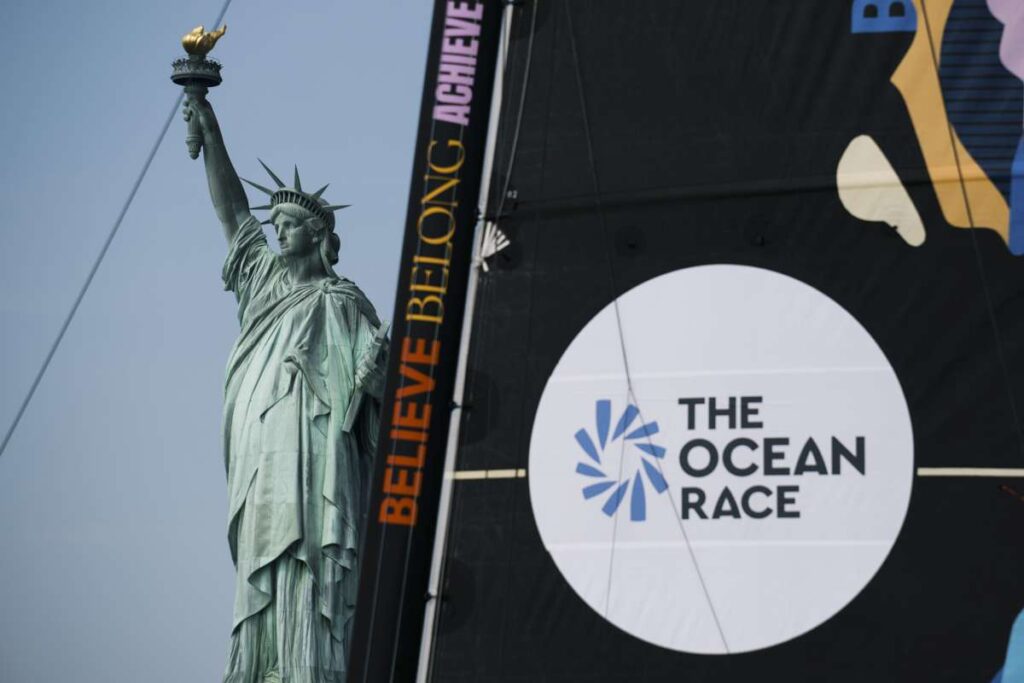
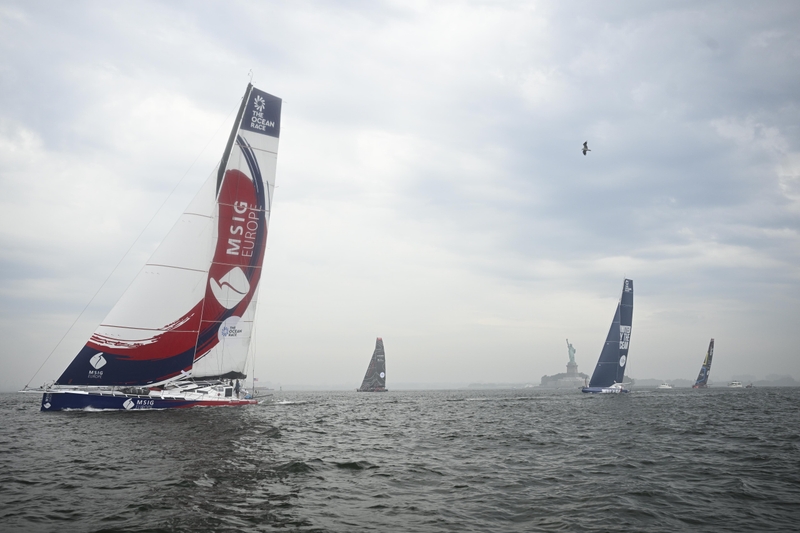
The six international IMOCA crews competing in the inaugural edition of The Ocean Race Atlantic left New York Harbor after a ceremonial start in front of the Statue of Liberty.
Earlier on Tuesday morning, at the Brooklyn Bridge Marina where the fleet has been based for the past five days, the four-person gender-balanced crews and their on-board reporters paraded down to their boats, before docking out one-by-one, waved off by their shore crews and cheering fans.
The fleet of 60-foot foil-assisted high-performance racing yachts will now transit through a series of marine mammal exclusion zones off New York City at low speed on their way to the official start area located around 150 nautical miles offshore.
Here, the crews will switch to race mode when the transatlantic sprint to Lorient, France is scheduled to officially get underway at 0600 Eastern Time (1200 CEST) on Wednesday, September 2 – although expected light conditions on the way to the start area may necessitate a short postponement.
With many of the crews racing in the transatlantic race also intending to take on the around-the-world edition of The Ocean Race starting in January 2027, the 3,000-nautical-mile passage through the North Atlantic will provide teams with a valuable opportunity to test their open-ocean performance relative to their rivals.
Despite having to deal with light conditions and potential thunderstorms on the way to the offshore start area, the forecast weather for the race itself suggests the crews could be in for a fast ride across the Atlantic. Just how fast depends largely on how well the sailors deal with a fast-moving low-pressure system travelling eastwards with the fleet, bringing strong winds and fast-running conditions. Pre-race routing suggests that the leaders could take between six and nine days to reach the finish line off Lorient.
Team Malizia’s Cole Brauer (USA) believes the first day might be the toughest part of the race, weather-wise.
“We are going to be dealing with the Gulf Stream, light winds – it’s predicted to be pretty flukey and up and down – then deciding on whether you take the north route or the south route,” she said. “But, once we get going, we have five days of bombing all the way down to France.”
Those who take the best advantage of this strong weather system could have a chance of breaking the race’s 24-hour distance record of 641.13 nautical miles (1,187.39 km), set by Boris Herrmann’s Team Malizia crew on Leg 5 of The Ocean Race 2023 from Newport, Rhode Island, to Aarhus, Denmark.
As well as proven boats like Paul Meilhat and Mariana Lobato’s United by the Ocean (which as Biotherm won The Ocean Race Europe 2025), Francesca Clapcich’s 11th Hour Racing (the boat which raced around the world as Team Malizia in The Ocean Race around-the-world edition in 2022-23), and Oliver Heer’s Embrace the Challenge (which as TeamWork – Team Snef was sailed to eighth place in the 2024-25 Vendée Globe by Swiss sailor Justine Mettraux), the fleet also features two brand-new boats in Boris Herrmann’s Malizia 4 and Kojiro Shiraishi’s DMG MORI GLOBAL. Meanwhile, MSIG Europe is an older-generation non-foiling design that – as MS Amlin – skipper Conrad Colman raced to 21st place in the 2024-25 Vendée Globe.
This edition of The Ocean Race Atlantic is the most accessible ever, with live connections to the fleet each day for the OnBoard Live Show at 1700 CEST / 1500 UTC via www.theoceanrace.com and youtube @theoceanrace.
#TheOceanRace #IMOCAracing
More Offshore Sailing stories: Click here