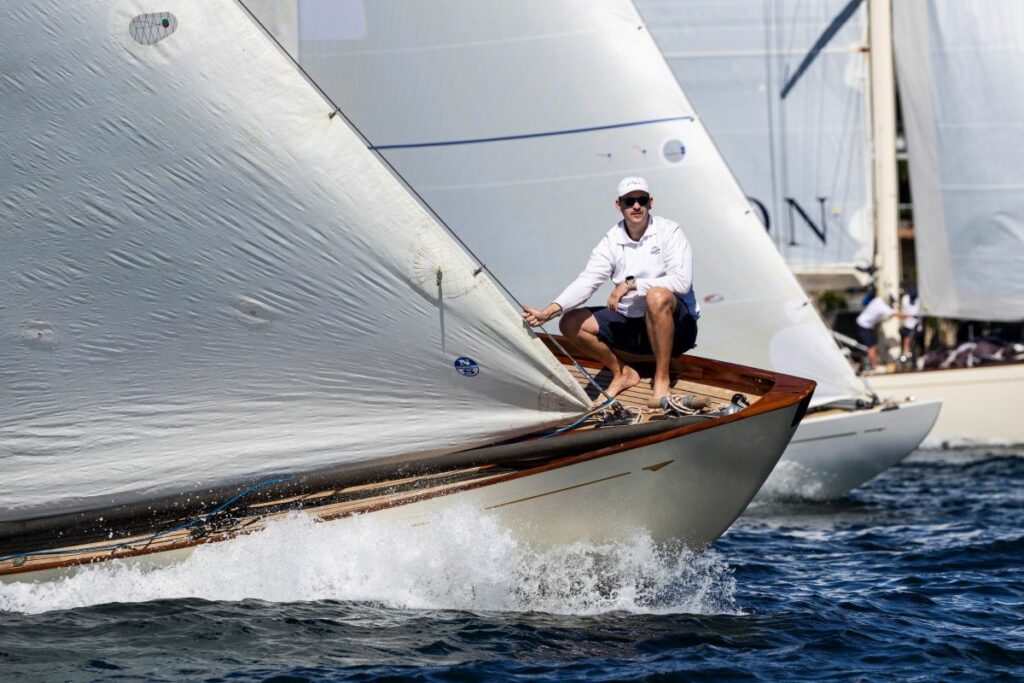
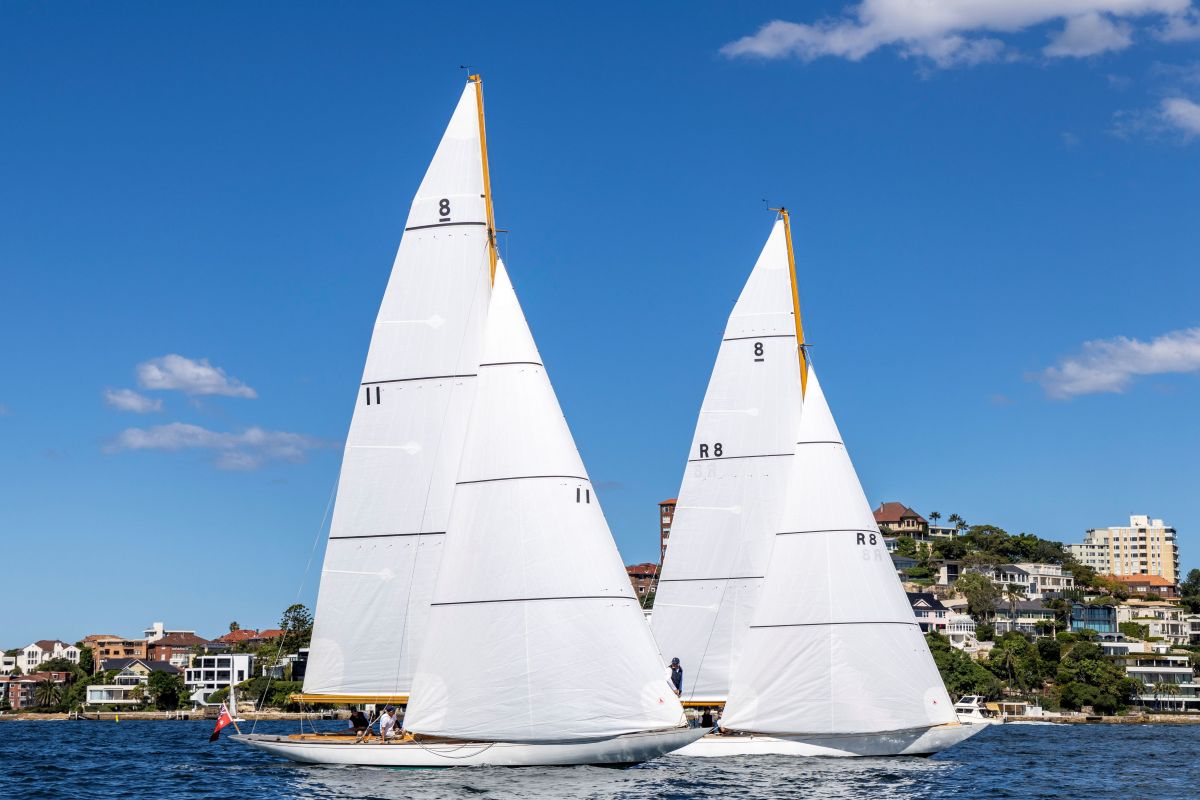
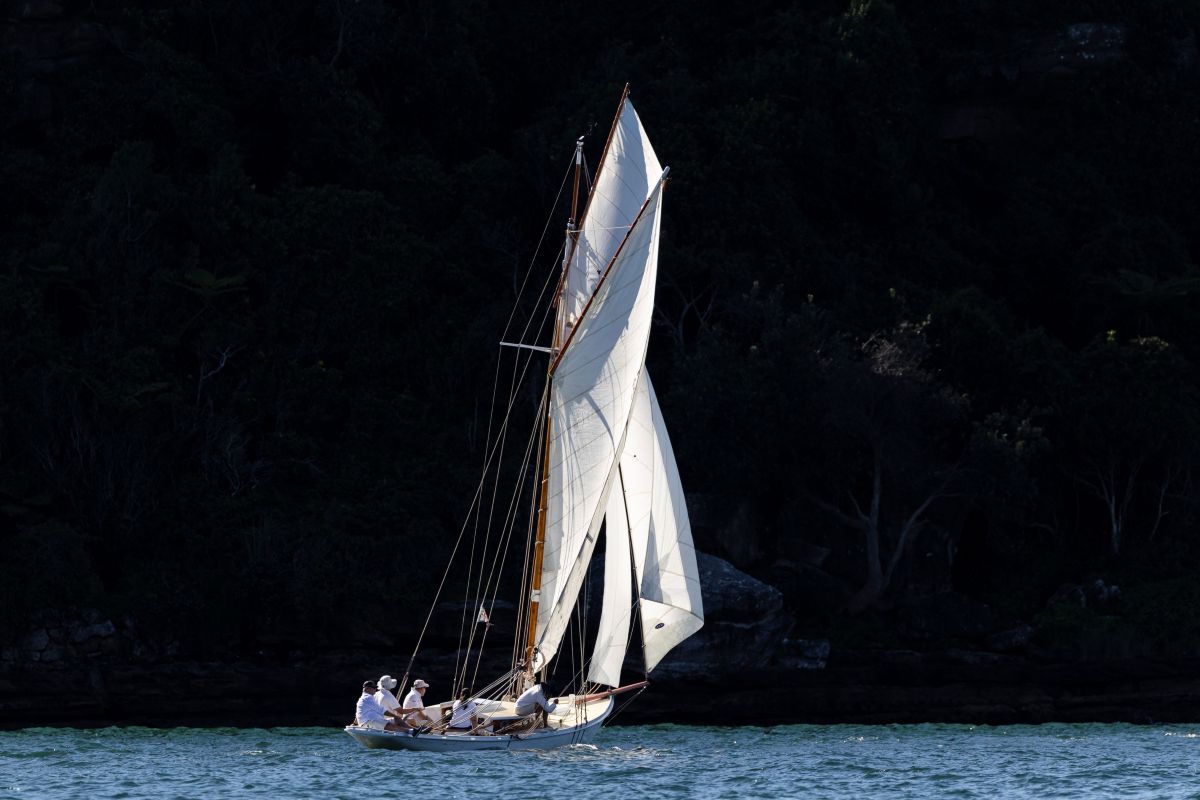
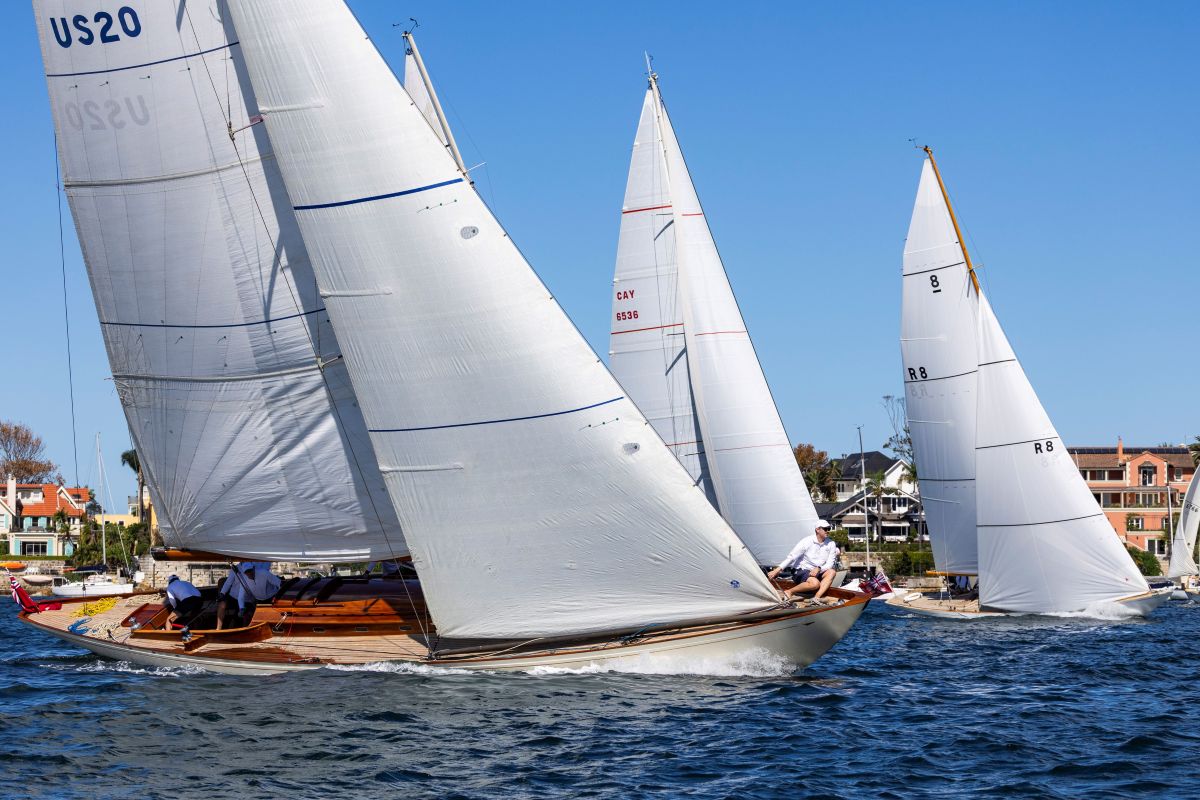
The option to race under IRC proved a real drawcard for competitors in the inaugural Classic Yacht Regatta hosted by the Royal Prince Edward Yacht Club (RPEYC) in April on Sydney Harbour, with 27 of the 63 classic yachts racing under IRC Standard rating.
The dual-rating regatta, featuring IRC alongside PHS, was a first for a classic yacht regatta in Australia. It was created under the auspices of new RPEYC Commodore Sven Runow, a bowman who, over a 40 year period, reaped multiple line and overall Sydney Hobart honours including on super maxis Wild Oats XI and Andoo Comanche.
Runow has a broad sailing knowledge base. His business is Assess Marine, which undertakes marine surveying, assessing and consulting. He said IRC was a positive introduction to the event.
“The event was run in IRC and PHS, so we could have as many boats as possible competing by giving people choices.”
The high number embracing IRC, coupled with those racing PHS, has guaranteed the event will become an annual affair. “We hope to have 100 boats next year,” Runow said
Runow was unsurprised so many owners – including for the first time in Australia several International 5.5’s and 30 Squares, E30’s and, in a world first, a pair of Couta boats – all lined up for an IRC Standard certificate. “We publicised it in advance and it was a great effort to encourage and help people to obtain their certificates,” he said.
Dedicated measuring days, overseen by IRC measurers David Kellett, Ian Guanaria and Chris Zonca, were held especially at the Cruising Yacht Club of Australia and Royal Prince Alfred Yacht Club and proved so popular, they will be offered again going forward.
“IRC Standard was a great initiative to offer a chance to win inshore regattas and divisions, rather than the same boat winning a lot of the time, which seems to happen in PHS and some other measurement systems. The lower cost is an important factor and I feel confident more people will measure ahead of our next Classics regatta,” Runow said.
“The Edwards has always been a progressive racing club. Clearly it was time for a proper annual classic regatta, with stimulating rating opportunities and a full Concours d’Elegance. We want to create a tradition at the Club – and what better way than with Classic yachts?
“I brought classics enthusiast and ‘Edwards’ member, Nicole Shrimpton, onto the committee to help create the regatta. Nicole is the owner of a pair of Australian 8 metres, Defiance and Frances, both now racing under IRC. She became heavily involved with David Stenhouse, our new club manager, who runs the racing side of things. Without their input, it wouldn’t have been the event it was,” Runow ended.
The success of the regatta and the popularity of the event took the Club by surprise. The classic regatta format, typically seen on the European circuit, was a champagne cocktail party and dinner and formal Concours d’Elegance overseen by a judging panel
Classic yacht regattas, Runow predicted, all of which will include dual racing under IRC and PHS, will become the club’s niche. “We’re also holding a Couta Boat (a traditional Australian wooden sailing boat originating in the late 1800s) regatta later in the year and we’ll have a Classic division in our Centenary Regatta in November.”
A classic boats lover raised on timber vessels, Runow skippered his own Eva Ellen, the 36-foot converted gaff rigged lobster boat (built in 1937) in Division 5.
The regatta was well supported by the Sydney Amateur Sailing Club, traditionally the stomping ground of classic yacht racing. “They had 20 boats at our regatta and their Rear Commodore, Alice Murphy, sailed and was very complimentary.”
IRC Standard has been gaining traction in Australia, as more sailors become aware of it being a way to race in local club events with an objective rating rather than performance handicap.
To give some background, “IRC Standard certificates are not a recent addition to the IRC rule, but go back to its very roots,” explains Jenny Howells, Technical Manager of the Royal Ocean Racing Club (RORC) Rating Office,from where IRC Rating originated in partnership with UNCL in France over 40 years ago as the Channel Handicap System;CHS was re-branded as IRC in 1999.
“Endorsed certificates were introduced as an additional layer for higher-level racing, requiring verified measurements to increase accuracy and confidence in tightly contested events,” Howells said.
“However, when IRC was introduced in Australia, the Australian IRC Rule Authority made the decision to require all IRC certificates to be Endorsed, From June 2024, in the interest of getting more people into the sport, Australian Sailing changed this policy to also offer IRC Standard certificates and this is why it seems like a new IRC initiative to sailors in Australia.
“Standard certificates remain the dominant form of participation within IRC fleets in Europe and worldwide. They are used extensively in club racing, local regattas, and much of the day-to-day racing calendar, reflecting the rule’s original aim of inclusivity and ease of use. Endorsed certificates, by contrast, are typically required only for high-profile events.
“However, many owners hold Endorsed certificates, not because they require them for specific events, but because they want their rating to be calculated from the most accurate data possible; it also reduces questions from their competitors. Of all the currently rated IRC boats worldwide, 60 percent hold Standard certificates and 40 percent Endorsed,” Howells said.
“The long-standing acceptance of Standard certificates has been central to the growth and sustainability of IRC fleets worldwide. It has consistently allowed a wide range of boats to participate at the grassroots level without significant cost or administrative burden.
“Having said that, an important factor to note is that the fairness and accuracy of all IRC ratings, whether Standard or Endorsed, rely on good data (as with any rating system). The IRC Rule Authorities in each country, and the experienced IRC Rating Offices in the UK and France, are thorough in checking the inputs and data provided for Standard certificates to ensure the rating is as fair as possible,” Howells ended.
Iain Murray, whose knowledge from his experience as a sailor, boat designer andRegatta Director of major events such as the America’s Cup, is undeniable, said: “I think everyone is looking for a better way to race their boats. IRC has become the prominent and now clearly one of the more preferred rating system around the world. It’s certainly the gold standard for all the major regattas.
“What I like is that it’s a stable system based on a concrete set of numbers relating to every aspect of the yacht vetted by the measurer, Australian Sailing and then ultimately RORC.
“IRC is consistent and fair and is built on a huge, historical data base of the yachts of the world. There is no room for manipulation of the system or the outcome. It rates the boat, not the sailor. If you sail well, you do well. If you don’t, you don’t. And that appeals to the competitive sailor.
“I have noticed the Cruising Yacht Club of Australia is holding more races inshore under IRC. Now the word is getting out and the take up has been strong, with 27 boats for this new Classic Yacht Regatta, which is great.”
And this is where Shrimpton, who won Division 1 at the regatta with her pretty 1935 built International 8 Metre, Defiance, was effective. As an advocate of Classic boats and of IRC Standard and now with a second 8 Metre Frances (built 1948), also measured under IRC, she encouraged and helped the 27 to obtain their certificates in a concerted effort over six weeks.
At the regatta, Shrimpton’s boats raced in PHS and IRC. Interestingly, Frances won PHS Division 1 and placed third under IRC. “Both my crews were champing at the bit to race under IRC. It was thrilling and fascinating for us and most certainly a new way to race in classics,” she said.
Stephen Girdis, from a prominent three-generation sailing family, raced his 1945 built vintage metre boat, Plym, and finished second to Shrimpton’s Defiance in IRC. “I mainly race one-design, so I don’t come across IRC, but I responded to the desire of The Edwards and Nicole to pursue IRC Standard for the regatta,” he said.
“I couldn’t attend the IRC rating day, so Nicole and friends took care of it for me. You fill out the form and Australian Sailing sends it to the RORC and they come up with the rating. The outcome seems to be reasonable. We like the classic events and because so many (boats) were measured for IRC, we did it. The Club has proved it can easily be done,” Girdis ended.
Chris Antico entered two yachts under IRC Standard – Oenone, a Linton Hope Gaff Rig Cutter and Sea Rover, a converted Couta boat skippered by his son Reuben: “I am glad I did that. It’s not as difficult as one envisages to do it,” Antico said.
“The guys and girls who came to do it were helpful and easy to deal with. Oenone is 125 years old and Sea Rover is 100. Both are gaff rigged, so there’s nothing much in the way of other boats to compare them to. It made it interesting for them (IRC measurers).
“My boats are quite different and much older than the majority we race against weekly, so I’ve found IRC is a fairer rating system for us, as we are never racing like for like. Even though the other measurement systems work well, I couldn’t believe the difference in what we scored in PHS compared to IRC. There’s a reason we come last on PHS regularly – it’s because mine sail differently to the modern boats – especially Sea Rover.
“On days when there is little breeze, we may as well not go out, compared to when there’s a lot of breeze, when she ploughs along and can win. This is where PHS goes right out the window for us and IRC works really well,” said Antico, adding, “I know from experience there are certain races I’ll enter and others I won’t, for these reasons.“
Meanwhile, volunteering advocates of IRC such as Nic Doig, passionate IRC measurers including Michael Spies and IRC enthusiasts and boat owners such as Shrimpton, are committed to making more boat owners aware of what a difference IRC Standard can make. She says, “I can envision the day in the not too distant future when there will be a lot more boats on a Classics start line racing IRC.”
Di Pearson
#ClassicYachtRegatta #SailingAustralia #IRCRating #SailingNews #SailingCommunity
Interested in seeing more Racing News? Click here