Kristy Theissling, an Australian writer and sailor, is exploring the heritage of production boatbuilding through the story of Northshore Yachts. The narrative delves into the use of resin, mould logic, and the thoughtful systems thinking behind the construction of various models including the 27, 33, 38, and 46. Read on…..
I leap over the companionway steps to land with my feet pressed into the cabin sole, careful to stay clear of the running rigging, above me, tentative shouts of instructions cut across the breeze — some for me.
The boat leans hard into a portside rounding, and in a flurry of instructions above, I’m handed a collapsing blue kite — sixty square metres of billowing fabric. Tumbling spinnaker fills my vision and cabin. I haul it in through the companionway, pulling it across toward its bag in a well-practised power move — sun-warmed fabric working fast but gentle — until fingertips reach shackle, free them one by one and lay tack, clew, and head in the portside cabin corner, ready for packing.
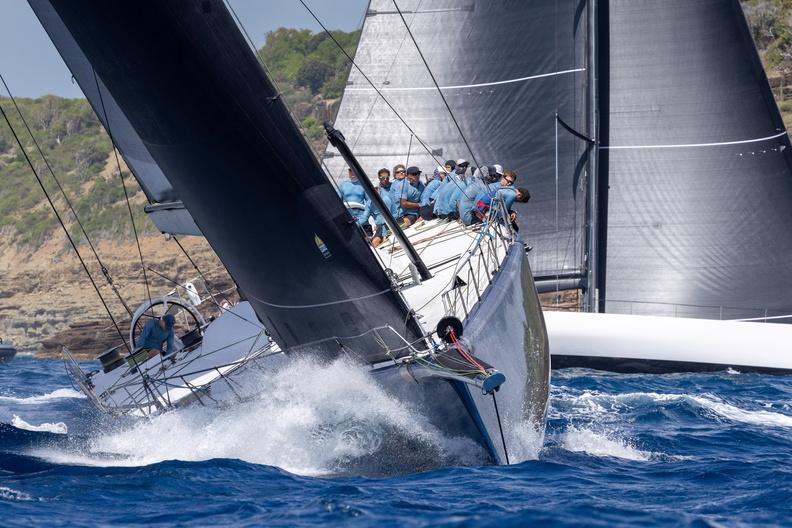
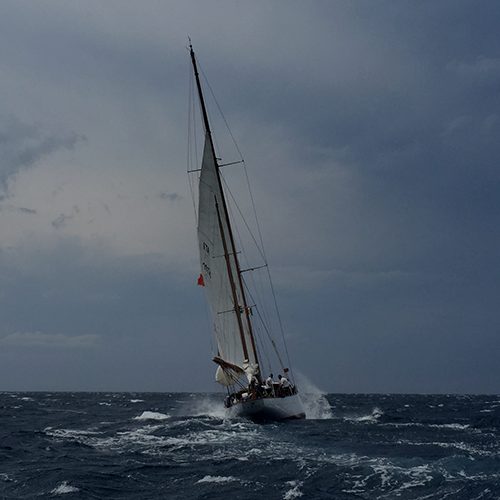
A small part of the Northshore legacy in motion. Northshore—an Australian line of efficient, lightweight production yachts—still draws a community together. It’s October 2025, and I’m crewing on a Northshore 38 in the Northshore Regatta at Broken Bay, RMYC Pittwater, among 100 crew and 15 sister boats.
Behind Northshore yachts is John Buck. Born in Hastings in the UK in 1940, this setting nurtured a resourcefulness that John took into an Australian boatbuilding legacy. Apprenticed young and arriving in Australia with 53 pounds to put towards some tools to start a business. John Buck shaped a Sydney-based evolution of design, production, and systems thinking.
Northshore Yachts began in the practical world of fibreglass repairs, where skill met necessity, and also where John discovered a medium for efficiency and design. It started with a bucket of resin and a roll of glass.
John started to explore the world of moulds and fibreglass in the late 60s and by 1980-1986 came in lineage the Northshore Yacht evolution. Initially the trailer-sailor Cole 23, then the 27, 33, 38, 46 and later, the 31.
In pursuit of amortised production, John tells me that it was his collaboration with Hank Kauffman that helped design ocean-ready confidence for Australian cruisers and racers.
Some of John’s creative ignition was influenced by a chance encounter with the Dufour 24, one of the first sailing vessels of the time to use a one-piece fibreglass insert an internal fitout, the most innovative thing he’d seen, reducing the overall fit out costs.
John recognised this as a good idea, and identifying and using good ideas was one of his practices.
John leveraged his trade experience and his time on factory floors and from his earlier work on the Cole 23, fibreglass moulds and understanding of repetition and production systems enough to set in motion aspirations for production boats.
The Northshore 27 became the first yacht under the Northshore banner — John’s understanding of the Australian marine industries and the markets needs and desires brought to life first successful Australian production yacht.
Material exchanges, moulding refinements, trade-informed decisions, durability, and ease of manufacturing: the 27 is the reason the lineage exists at all. John believed in his product and mortgaged his house to fund this dream.
The 27 a light, responsive hull shaped for inshore sailing; its fractional rig forgiving and easy to depower. John estimates 100 yachts produced.
The 33s deeper fin keel and sail area leap from 195 sq ft / 18.1 sq m (the 27) to 537 sq ft / 49.9 sq m (total) (the 33), translated to an offshore, adaptable racer or cruiser. The extra beam creates a hull that felt planted, and its generous interior brings the Northshore 33 to a cult status that still carries today. John estimates 80-100 produced.
The 38s, maintaining the fractional mast and more than double the weight of the 27, at 11,500 lb and 5216kg loves to be loaded up. John estimates 50-60 produced. Finally the 46, 15 meters and move from fractional masthead to traditional, this Bluewater passage maker, with an estimated 8 produced.
Flow. Waste reduction. Lean-agile instincts expressed long before the language existed. What was built at Northshore wasn’t just a fleet of yachts, but a philosophy of making. I’m curious about how this lineage of craft and quiet excellence carries forward into the community I’m a part of in 2025 — and I’ll be leaning in, writing more, and sharing what I uncover as this story continues to unfold for sailing and systems thinking.
For more updates and to follow the ongoing conversation about Australian sailing, consider checking out Kristy’s profiles: LinkedIn.
#AustralianSailing #NorthshoreYachts #BoatBuilding #YachtProduction #SailingCommunity
Want to see more Boats and Gear News? Click here