Understanding the shape of a sail has traditionally involved a combination of experience, observation and, at the professional end of the sport, specialist measurement tools. A new application called SailScan aims to make that process considerably easier, allowing sailors to analyse sail shape using little more than a smartphone and a photograph.
For many club racers, sail trim is something developed through experience. Sailors adjust halyard tension, outhaul, cunningham, backstay and other controls, watching how the sail responds and assessing the boat’s performance.
But how do you accurately measure the changes those adjustments produce? And how can you compare the shape of a sail in different conditions, or determine how it has changed over a season?
These are some of the questions behind SailScan, an application developed to provide sail shape measurements within seconds.
From the America’s Cup to a smartphone
The idea came from professional sailor and former sailmaker Alex Higby, whose experience includes working with Emirates Team New Zealand during the 34th America’s Cup, competing in the Volvo Ocean Race with Abu Dhabi Ocean Racing, and racing in the Extreme Sailing Series, 52 Super Series and Maxi campaigns.
Even at that level, obtaining accurate sail shape measurements could be a time-consuming exercise.
“Getting real numbers on a sail has always been slow,” Alex explains.
“Even on the professional programmes I sailed with, you’d take a photo, send it off to be digitised, and sometimes wait a day to get the shape back. By then the conditions had changed.”
His objective was to make that information available while sailors were still on the water and able to act on it.
SailScan has been developed by a small team, with Nate McGuire responsible for engineering and the computer vision model, and John Rodriguez handling the commercial side.
According to Alex, the team has developed its own image analysis model, trained using photographs of real racing sails.
How does SailScan work?
The process is relatively straightforward.
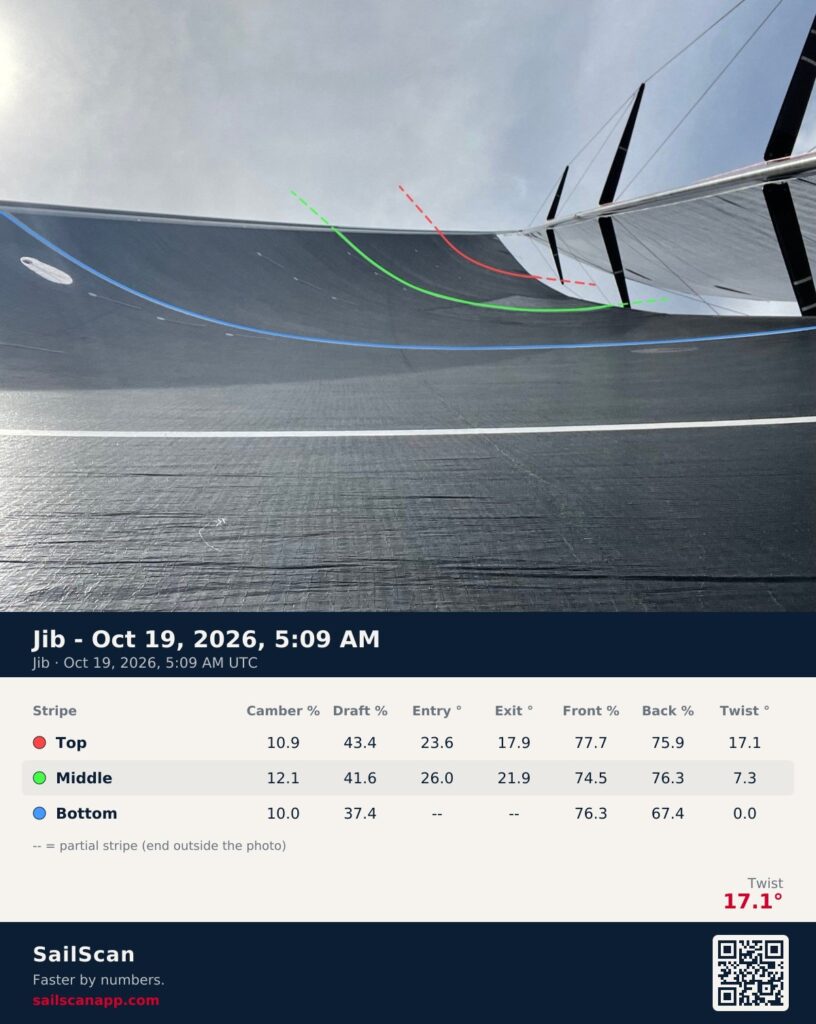
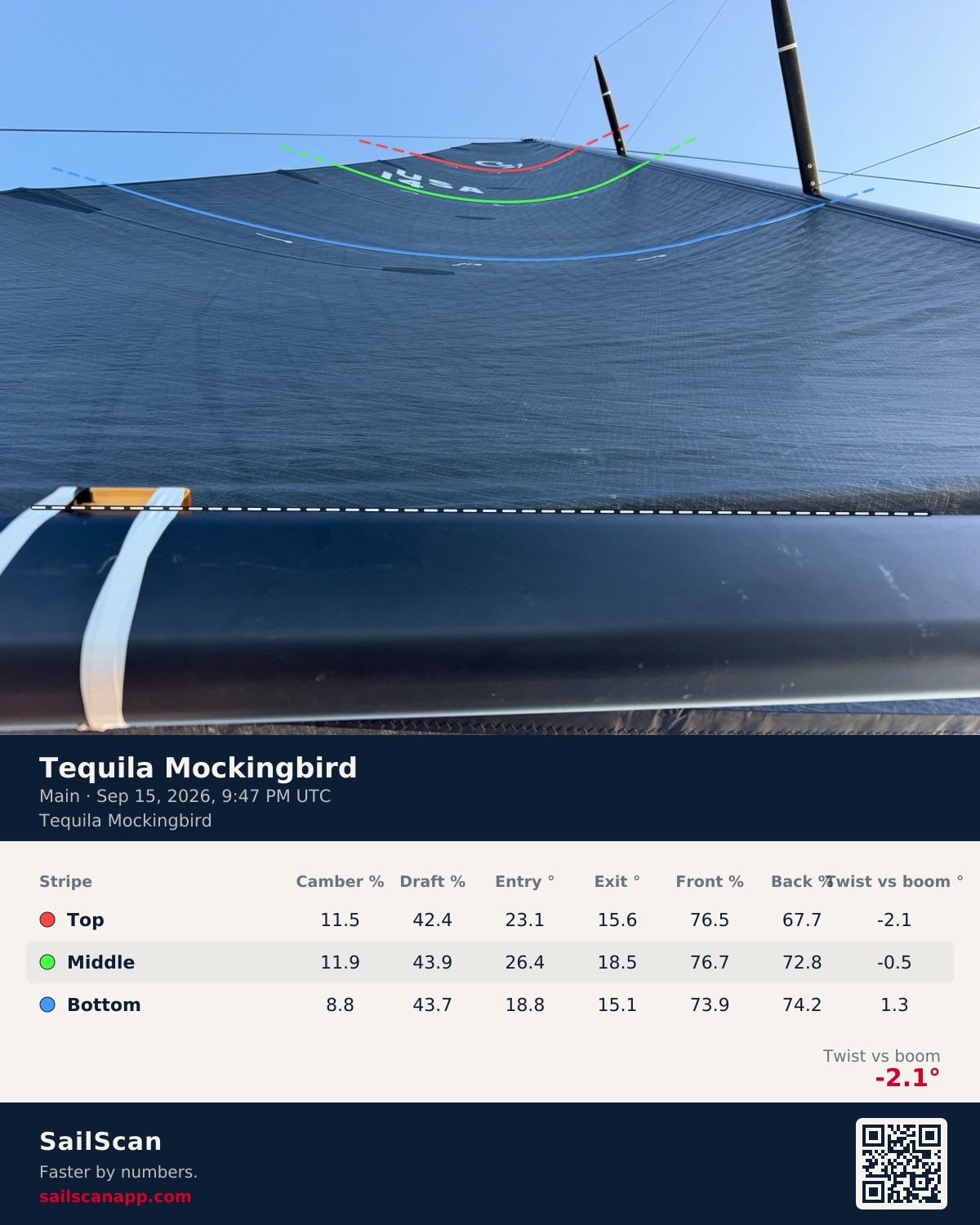
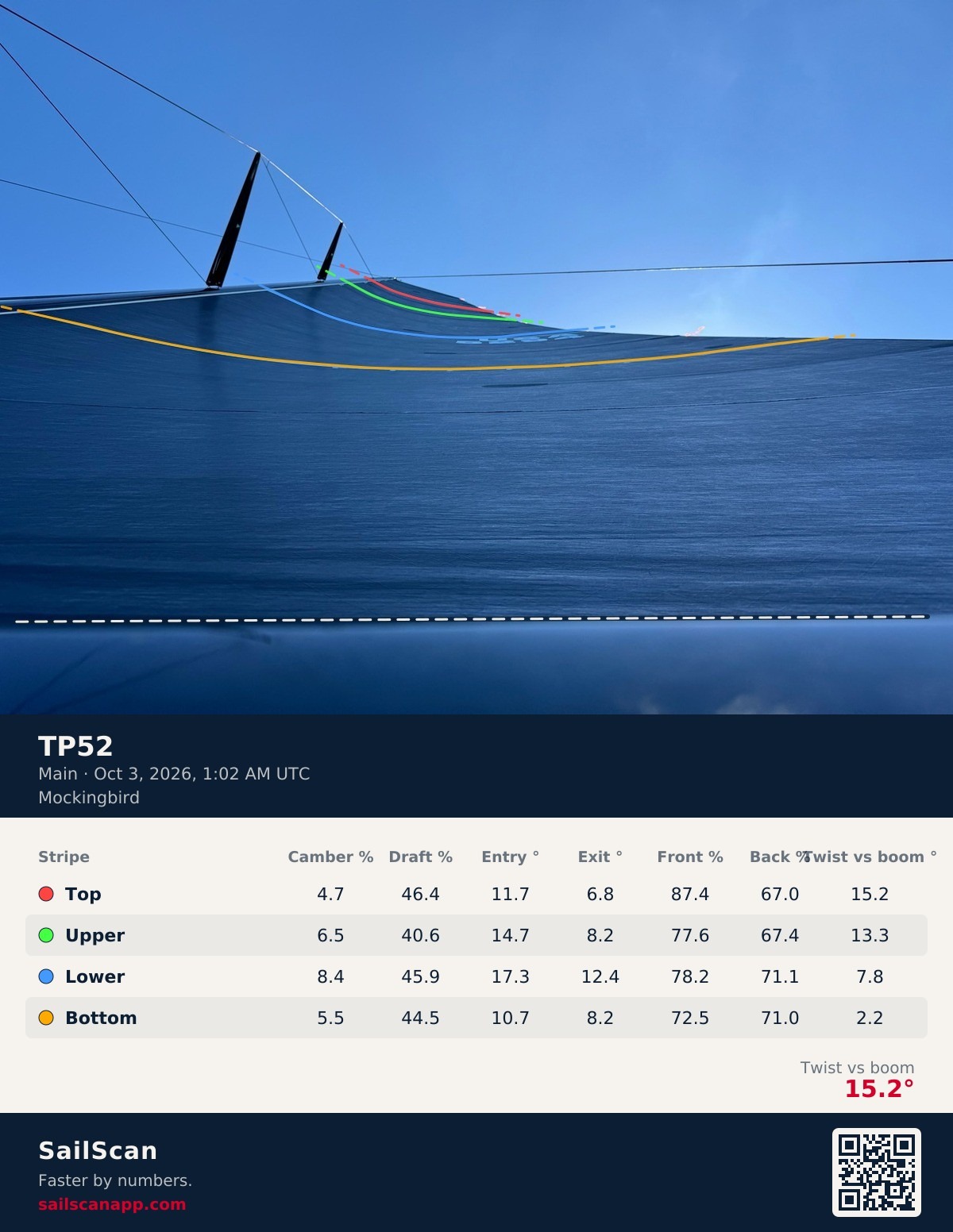
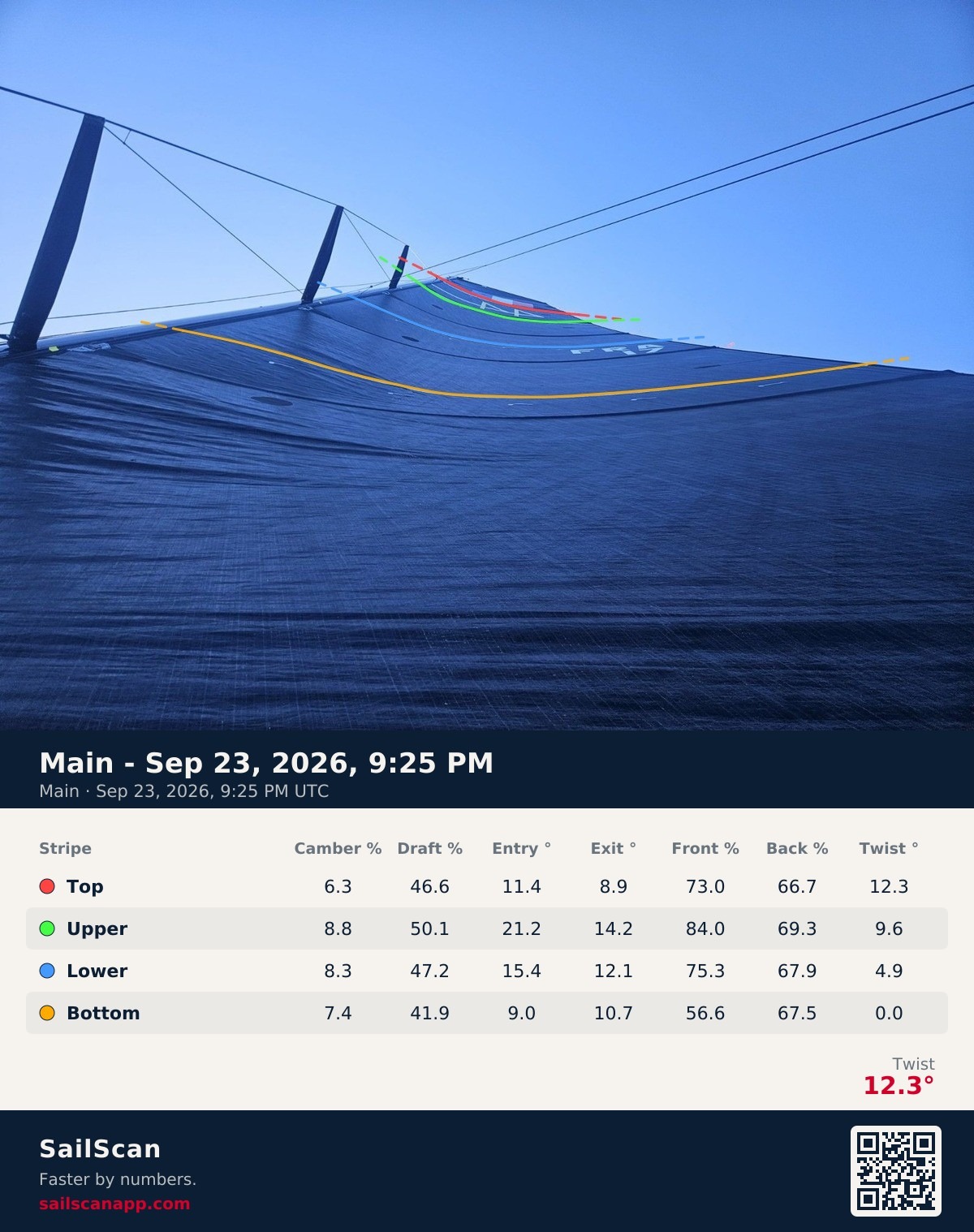
A sailor photographs the mainsail or headsail from underneath, around the midpoint of the sail. The sail must have draft stripes, which provide the reference lines used to analyse its shape.
SailScan identifies the stripes, traces them from luff to leech and calculates several key measurements:
- Camber: The depth or fullness of the sail.
- Draft position: Where the maximum depth occurs along the sail’s chord.
- Entry angle: The angle of the sail’s forward section.
- Exit angle: The angle at which the sail’s aft section approaches the leech.
- Twist: How the sail’s orientation changes with height.
The traced lines are displayed over the original photograph, allowing sailors to see what has been measured.
The application is designed to work with any sail carrying suitable draft stripes, from radio-controlled yachts and dinghies through to grand prix racing yachts and superyachts.
What does it mean for the club racer?
Perhaps the most interesting application is the ability to compare sail shapes rather than simply record a set of measurements.
A sailor could photograph the same sail in light and heavy conditions, or before and after changing rig tension, and compare the results.
Scans can be viewed side by side or overlaid, making differences in sail shape easier to identify.
This could be particularly useful in one-design racing, where small differences in sail trim and rig setup can contribute to differences in boat speed.
For example, two sailors racing identical boats could compare their sail shapes to see how different mast characteristics, sails or rig settings affect the resulting profiles.
Importantly, SailScan is not intended to leave sailors with a collection of numbers to interpret entirely on their own.
According to its developers, the application also provides suggestions for refining sail trim based on the measurements obtained.
Whether those suggestions translate into improved performance will ultimately depend on how sailors apply them and assess the results on the water.
Nevertheless, the ability to quantify changes that might otherwise be judged largely by eye could provide a useful additional tool for sailors looking to improve their understanding of sail trim.
Tracking sails as they age
Another potential application is monitoring how sails change over time.
A new sail could be scanned when first delivered, establishing a reference shape. Subsequent measurements could then be compared against that original profile as the sail accumulates racing hours.
For sailmakers, this could provide a more objective way to discuss sail condition with customers, identify changes in shape and assess whether a sail might require attention.
For boat owners, it could help distinguish between a problem with sail trim or rig setup and changes associated with the sail itself.
Sharing information with the crew
SailScan also supports sharing measurements between members of a sailing team.
This means trimmers, tacticians and coaches can review the same sail shape information during a post-race debrief, rather than relying solely on individual observations.
The application can also be used alongside race data in NJORD Player, allowing sailors to examine sail shape information in the context of their sailing performance.
Combining measurements with observations about wind strength, sea state and boat speed could make the information particularly useful when building a record of settings that work well in different conditions.
Available across multiple platforms
SailScan is currently free to use and is available for iOS and Android devices, as well as through a web interface.
Photographs can be uploaded for analysis, with results synchronised across the supported platforms.
The developers say the underlying computer vision model is updated weekly as they continue refining its performance and adding features.
For now, the main attraction is the opportunity to obtain sail shape measurements quickly, without the specialised analysis process previously associated with professional racing programmes.
SailScan is unlikely to replace the experience of a good sail trimmer or the expertise of a sailmaker. But it could provide another useful piece of information in the continuing search for better sail shape and improved performance.
For club sailors who enjoy experimenting with rig settings and comparing notes after racing, that alone makes it an interesting development.
More information: sailscanapp.com
#Sail.Scan #SailTrim #SailRacing #SailingTechnology
Interested in seeing more Boat & Gear News?