Hull & Humber has been involved in a dramatic rescue of one of their
crew members following a man overboard incident in the South Atlantic,
1,400 miles from the team's destination of Cape Town, South Africa.
Arthur Bowers, 51, was climbing towards the main companionway at the end
of his watch when the boat was hit by a big wave, knocking him sideways,
down the deck and through the guard wires into the water. He was wearing
his lifejacket which automatically inflated when he entered the water
and had just unclipped his safety line to allow him to descend the steps
into the saloon.
The crew, who carry out endless man overboard drills during their
pre-race Clipper Training, immediately put theory into practice and, in
an excellent display of seamanship, recovered Arthur and had him safely
back on board within 17 minutes.
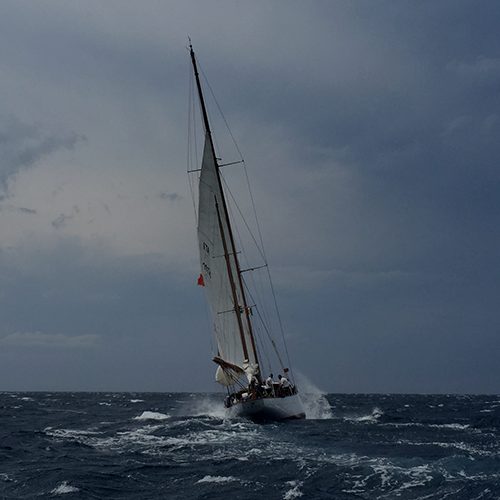
The incident happened at 1345 GMT during daylight hours in the South
Atlantic where the waves were six to eight metres high. In winds of 25
to 30 knots Hull & Humber was sailing with the Yankee 3 headsail,
staysail and three reefs in the mainsail. The crew reacted quickly,
according to Hull & Humber's skipper, Piers Dudin, 31. The
Salisbury-based skipper was at the chart table at the time and
immediately pressed the man overboard button on the GPS system to mark
on the chart the position at which Arthur entered the water.
Piers said, “Bex (Rebecca Mayman, 19) was pointing at Arthur's position.
After heaving to, we released the preventer line and centred the main
and dropped the Yankee 3 and staysail. We started the engine and motored
back upwind to him – at this time we were about 150 metres away.
“Jeremy (Reed, 54) put on the harness while the rest of the watch
prepared the halyard to allow him to be lowered over the side to reach
Arthur. During this time we circled Arthur twice and on the third lap
came up close to him on the starboard side. We didn't reach him on the
first attempt.
“I stationed Hull & Humber with Jeremy low in the water next to Arthur.
On the fourth lap we lowered Jeremy to him and he attached a staysail
halyard to Arthur's lifejacket and both were hauled up. Arthur held onto
the helistrop and supported himself as he was hoisted.
“He walked himself back to the cockpit and walked below to get out of
his wet gear. Charlie (Charlotte Mulliner, 21) had prepared a sleeping
bag for him in the saloon.”
As soon as he was back on board he was checked for signs of hypothermia
and for shock and has no other injuries. Piers, in common with every
ocean going commercial skipper including those in charge of tankers and
cruise ships, has the Marine Coastguard Agency (MCA)'s certificate of
Proficiency for Persons in Charge of Medical Care on Board Ships. In
addition he has the support of medical professionals in the crews of the
other Clipper yachts and via the UK's Maritime Rescue Coordination
Centre (MRCC) in Falmouth if required. He is continuing to monitor
Arthur's condition and, as a precaution, he is monitoring the rest of
the crew for symptoms of shock.
Piers rang the Race Office at 1413 GMT to report the incident and
Arthur's safe recovery and his next of kin have been told.
Race Director Joff Bailey says, “Man overboard manoeuvres are practised
daily in training to cover this situation. That Piers and his crew
reacted so quickly and efficiently is a testament to the high standards
set during the pre-race Clipper Training which has helped them develop
their skills as ocean racing yachtsmen and women.”
Hull & Humber was in second place in Race 3 of the Clipper 09-10 Round
the World Yacht Race from Rio de Janeiro, Brazil, to Cape Town, South
Africa, when the incident happened. They returned to the position at
which they started their engine and have now resumed racing – and Arthur
can't wait to get back up on deck and take the helm. The team has
dropped down to third place, 17 miles behind the leaders, Cork, Ireland.
The first boats are expected at Royal Cape Yacht Club in Cape Town on
approximately 14 November.