Cruising Helmsman
March 2009
By Sharon
Smallwood
Sharon Smallwood and her husband Julian explore one of Australia's most remote regions.
Perhaps
it was the lure of places closed to casual visitors. This certainly aroused my
interest. Perhaps because Brilliant II was travelling the “wrong
way,” shorter passages and sanctuary between them seemed the best solution
for a voyage to windward. Perhaps the appeal lay in weaving our own songline
into the realm of the Dreaming. Probably a combination of these things saw us
plotting a course from west to east across Arnhem Land.My husband Julian hates
the word “unsurveyed”. Information on this remote part of our
continent is hard to come by and even our charts paint an unfinished picture. The
popular westbound milk-run route typically stays offshore, thereby avoiding
scores of undocumented hazards. Assisted by a healthy dose of caution, we
headed into the relatively unknown.
First stop
Croker Island was our first stop
in Arnhem Land and an unplanned one at that. Departing
the Cobourg Peninsula
we intended to sail down the Bowen Strait, taking anchorage at either Valentia Island
or Malay Bay. Gusts of more than 30 knots on the
nose caused us to re-evaluate. Suddenly the protection offered by Point David
on Croker's southwestern shore seemed a more attractive proposition. With the
Aboriginal population supposedly concentrated at Minjilang on the east coast,
it surprised me to see buildings and a jetty as we closed the land. Through the
binoculars we now also spied rows of small buoys where we had hoped to drop the
pick. Could this be an oyster lease? Veering sharply away we sounded out a new
spot. Julian, ever the hunter-gatherer, got straight to work with his rods.
Thoroughly absorbed with reeling in a sweetlip emperor, it took the sound of an
engine to remind us we were not alone. My heart sank as the speedboat
approached. I guessed our visitor would ask us to move, a daunting prospect
given the near gale and failing light outside. Happily my fears were unfounded,
the call merely out of concern for our ground tackle. “We're a pearl
farm,” the man replied to our enquiries. Such establishments are common
throughout northern Australia
and Arnhem Land is no exception. Not content
with just the one catch, Julian persevered until we had a flowery cod to add to
the collection. A seafood dinner sustained all aboard, the ship's cats Pepe and
Carlos enjoying sashimi, while we feasted on fillets barbecued in Cajun spices,
served with a garden salad.
Off at dawn
We resumed our journey at dawn, reefed
sails and broad tacks increasing the crew's contentment. Islands in this
vicinity include New Year, Oxley, Lawson, Grant and McCluer, the latter
providing the pick of the anchorages. It's tempting to swim in the turquoise
waters off pristine white sand beaches, but growing numbers of protected
crocodiles discourage this activity. Game-fishing, a slightly safer sport, can
be pursued at New Year Island, reputedly a “hot spot”. Going ashore
in any of these locations requires a permit because they all fall within the
Arnhem Land Aboriginal Reserve, a 97,000 sqkm section of the Territory,
returned to its original inhabitants. Back on the mainland the scenery at Malay Bay
typifies this stretch of coast. Low-lying dunes supporting little in the way of
vegetation beyond patches of scrub, meet an aquamarine sea beneath the intense
blue sky. The bay owes its name to the Maccassan traders of Sulawesi
who frequented it from about the 18th century onwards. In search of trepang,
otherwise known as sea slugs or beche-de-mer, they arrived around November on
the first winds of the northhwest monsoon. Harvesting this delicacy took them
across to the Gulf of Carpentaria until the
southeast trades resumed to blow them home. Relics of these bygone days have
been excavated throughout the Northern
Territory. Tamarind trees remain a legacy of our
Asian neighbours – Maccassan words and songs still pertinent to our indigenous
peoples. Here in the lonely parts of our country we remember how far beyond
European discovery Australia's
history extends.
North Goulburn Island
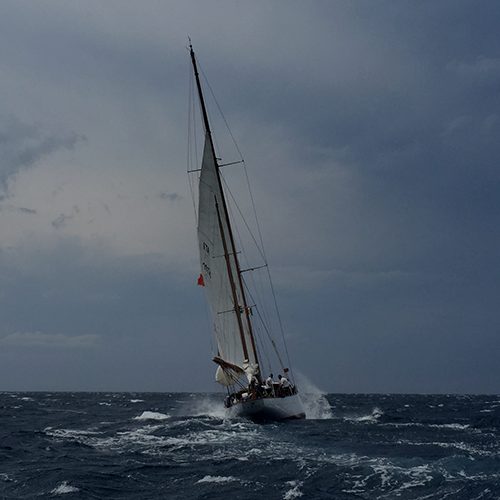
A 50nm run saw us punching through short
steep seas to reach North
Goulburn Island.
Little depth and wind-waves without much space between them, combined with the
fetch of the Arafura Sea beyond, had us
dipping our bows and hanging on. The ship's bell chimed as Brilliant II fell
off one crest only to be picked up by another. Having four feet appeared to be
no greater aid to stability for our feline passengers. Pepe and Carlos wobbled
around below decks searching for somewhere to wedge themselves in. They, like
us, found the pilot berth pretty secure. Banging, crashing and dropping into
troughs in what Julian renamed the “Arafurious” Sea, made these
passages some of the most challenging in our cruising lives so far. Easing
sheets for slower progress afforded as much comfort as possible, but even so
attempting a visit to the head was comparable to tackling an assault course. We
remained in remarkably good spirits throughout, nonetheless happy when Mullet Bay
came into view, and virtually ecstatic when the water smoothed out in her
lee.
Cultural significance
Once again it intrigued me to spy a couple
of buildings ashore. The traditional owners reside at Warrawi on South Goulburn
Island, only frequenting
their northern neighbour when ceremonies or rituals dictate. The particular
significance this island holds for the Aborigines associated with it caused me
to question my own presence here. Although in possession of documents allowing
us to go ashore, when it came down to it I was unexpectedly embarrassed by my
ignorance. That we could traipse along the idyllic beach completely unaware of
what makes this a sacred site did not seem appropriate. Were we through lack of
knowledge capable of accidental desecration? Though I imagined not, since
consent to our application to visit was freely given, I felt that I would
rather be invited than invite myself. Even without authorisation the passing
yachtsman can, out of necessity, call into the townships of Arnhem
Land to replenish supplies. The extreme isolation of these coastal
settlements sees them serviced primarily by aircraft and barge. Rather than
stretch what must already be limited resources, I preferred to stock up in
advance. More than anything I wished for the ability to speak the Yolngu
dialect and thus communicate my concerns and curiosities. We remained on board,
content for now just to look on this vast and wonderfully wild land, without
impacting it at all.